12/30/10

Net Neutrality

Net neutrality is the idea that all parts of the internet should be equally accessible by all of its users.  For the most part, this is how the internet has always been.  The internet has opened up an amazing channel of instant global communication and any supporter of a free and open democracy would have a hard time arguing against this idea.  Congress has introduced a bill with the aim to keep the internet free and open, it is called the net neutrality bill.

The debate over net neutrality is not about internet freedom, but rather WHO can we trust to ensure that it stays neutral.  In some circles, there is mistrust towards the government’s ability to regulate anything, let alone something as important as the internet.  They feel that every regulatory bill passed will contain ear notes, and in the end is just expanding the bureaucratic mess in washington.  Others feel that when left to their own devices, corporations in a free market will see profits as the bottom line, and that to protect the consumer, the state must regulate the market.

I don’t think anybody – other than the CEO of Comcast who probably thinks that Netflix is getting an unfair free ride – is opposed to equal and open access to the internet.  Personally, I do not trust the free market to continue to provide a neutral internet.  I believe that a free market can only operate with the consumer’s best interest in mind when the consumer is educated and informed.

I do not trust the intelligence of the average internet user to be able to make these decisions.  There is a vast disconnect between the technology that we use in our society, and the average user’s understanding of how this fantastic technology works.  Thus, the average user is not even aware how they are voting with their dollar.  I think Huxley was right when he envisioned his dystopia in a Brave New World.

Net Neutrality – a working definition

Before we can analyze how effective the bill is, we need to clearly define what net neutrality is.  Net neutrality in general, is the equal and open access to all information on the internet.  In my opinion, there are three specific conditions for internet service providers (ISP) to follow, they are:

1)     No preferential treatment can be given to any data that is exchanged over their network; especially in the form of exclusive content from different content providers.  Data is data, and you must treat all data equally.
2)     To different forms of data exchange.  All forms of data exchange should be treated equally, for example between DNS web browsing, peer to peer file sharing, or bit torrent.  Data transfer is data transfer, and you must treat all data transfer equally.
3)     Tiered pricing packages.  ISPs could create tiered pricing packages for access to different types of content.  For example, basic internet functions such as email and news would be included in the base package, and you could purchase higher packages for sports, or social networking, or gaming for extra costs.  This graphic does a good job illustrating the point: http://i.imgur.com/5RrWm.png


In my opinion, the first point is by far the most important point.  I fear that that an ISP could create two information highways over their network – one highway would be a super fast, and the other highway would be much slower.  The ISP could then lease out the fast highway to richer companies that could afford it.  On the surface, this seems like a fair business plan - creating new markets, allowing competition, letting the market set prices, thus driving innovation – all healthy concepts for a free market economy.   But the real fear is that a news media company – such as CNN, Fox News, or MSNBC for example – could sign an exclusive deal with the ISP so that only their content is transferred over the super fast highway.

This would have a profound impact on the free flow of information.  If a news media organization has a political agenda, than that gives them an enormous amount of power to influence public opinion and public elections.  This is a scenario in my opinion that should be avoided at all costs because the free and equal access to information is vital for the continued operation of a free democratic society.

The second point relates to an ISP throttling or introducing a bandwidth cap, without the users knowledge, to certain types of internet activity, discriminating based on the form of data exchange.  Comcast has already done this, by actively reducing the amount of bandwidth available to a user who uses bit torrent to transfer data.  To me, although this is a smaller issue, I see it as an unfair business practice.

The third point, regarding tiered pricing packages, I have mixed feelings.  A tiered pricing package could be beneficial for some consumers, such as the grandmother who only checks her email twice a month.  I think a tiered pricing package can be left alone to the free market.

The Bill

Congress has proposed a bill to introduce new regulations to ISPs that aim to keep the inernet open and neutral.  To my surprise, I found the bill to be quite readable.  It was intuitive and overall made sense.  I read in detail the first two chapters, about 40 pages out of the 194.  If I can sit down and spend three hours and read 20% of the bill, then if a congressman who whose job it is to read and vote on bills complains or uses the excuse that a bill is too long in such a way to detract from the integrity of the bill, realize what they are actually saying is this:
“I very much enjoy having power, but I am very lazy, and I do not like to work very hard. So, please don’t vote for me in the next election.”
The ful 194 page bill is available here in PDF format:

And a summarized five page version of the bill that outlines the key points and rational is available here:
http://www.fcc.gov/Daily_Releases/Daily_Business/2010/db1221/DOC-303745A1.pdf

Edit:  For the sake of readability, I removed almost all of my running notes.  Instead, here is a much shorter and succinct analysis.

In my opinion, the first two chapters clearly define the issue, and present a solid argument as to why regulation is needed.  They provide ample evidence that clearly demonstrates that ISPs do not have incentives to keep the internet open.  The authors of the bill acknowledge that a debate exists, and work to address all of the major concerns that are presented about introducing this regulation.  They recognize the importance of the free market in its ability to drive competition and innovation - and that a free and open internet is essential.

Youtube is a great example of a company that has created new markets and driving innovation.  Youtube allows individual content creators to easily create and distribute their original content.  However, this can only work on an open and free internet.  If ISPs can charge end users extra fees to upload or download videos, this will stifle certain markets and limit overall innovation.

Here are two excerpts in particular that caught my eye, because of the language that they use.

Paragraph 41, page 25:
The Supreme Court has recognized that even if the Commission cannot “predict with certainty” the future course of a regulated market, it may “plan in advance of foreseeable events, instead of waiting to react to them.”
This could set a dangerous precedent.  They claim that the supreme court has already given the congress power to regulate in advance. I feel like this makes it easier for government officials to abuse power in the name of honest intentions - similar to preemptive attacks of war.  I can understand the argument in its favor, it is favorable to not have to react to an abusive corporation, but can we trust the government to have honest intentions?  This appears to be a larger issue than just this bill.

Paragraph 81, pages 47-48.
In the Open Internet NPRM, the Commission proposed that open Internet rules
be subject to reasonable network management, consisting of “reasonable practices" employed by a provider of broadband Internet access service to…
I am not comfortable when bills contain vague language like “reasonable practices.”  Reasonable to who?  To the consumer?  To the company?  To the share holders?  To the FCC?  Reasonable is a subjective word, what is reasonable to one person may be completely unreasonable to another.  Its use almost necessitates a discussion to be had my lawyers over how to interpret it.  Why not avoid that situation by using language that is clearly defined.  Furthermore, the use of "reasonable practices" provides a massive loop hole that would make everything else in the bill useless.  Before I can support this bill, language like this must be removed.

Conclusions

I think the FCC shares the same concerns that I have and has a compete understanding of the situation regarding the neutrality of the internet.  Like I previously stated, I do not trust corporations to be both innovative and sensitive to the consumers best interests at the same time.  However, I also share the disdain towards the inefficiencies and the sewer of corruption that a massive bureaucratic organization creates.


Everyday I have to watch more and more advertisements for trinkets or services that I do not want that slowly drain the very essence of my soul.  I have to watch corporations and marketing teams put a dollar on everything, and show a disregard to the health of the consumer and the environment.  Everyday my freedoms are eroded in the name of national security.  By a government that is quickly expanding its power, in the form of warrantless wiretapping from the Patriot Act or the new TSA security procedures at airports.


I do not know who to trust and I am torn on this issue.  I cannot trust the corporations because profit margins are their only bottom line.  Maybe this bill is well intentioned, but what if a single author put in a seemingly benign phrase that could later be interpreted as to justify a massive increase in state power?  Has there ever been a state institution that willingly let go of its own power?  Can I trust the FCC to regulate something as important as the internet - the single most effective tool of communication that has ever been invented - with perfectly honest intentions from all of its agents?


In conclusion, I have to support the net neutrality bill.  If the ISPs have control over access and what information can be on the internet, they then control public opinion and future elections.  I am not comfortable with the amount of power that the state and that corporations have, but its in our best interest to keep them opposed.  If those two powers merge, then there is no hope for democracy.

I feel like I have a pessimistic and hopeless view of the current state of affairs.  Often times it feels as though the situation forces a decision between the lesser of two evils - both options are bad, but one is a little less bad.  But that is the reality of the situation.  Anybody who tries to portray any vote or situation as black and white, as good versus evil, is being dishonest at best.  Decisions on politics, economics, and anything involving human nature are often times incredibly complex, and the only sane informed decision is "I don't know".

Its the struggle to understand the complexities of the situation where an honest and informed decision is made.  This cannot be done by watching network news or listening to their radio counterparts.  A free democratic society cannot operate with an ignorant or indifferent populace.  The conditions that breed these lazy mental states are those of arrogance, ignorance, and dogma.  When you are able to think critically and soberly analyze the facts for yourself - from primary sources and without a talking head doing it for you - you lose your arrogance, your ignorance, and your dogma.


More Net Neutrality Resources:

12/25/10

More wikileaks media reactions

This one was too good to pass up.  This clip is a gold mine for outrageous things to say.  Bob Beckel, a Fox News Business analyst, said the following,


Starting at the 1:00 mark:
"A dead man can't leak stuff... This guy's a traitor, he's treasonous, and he has broken every law of the United States. And I'm not for the death penalty, so...there's only one way to do it: illegally shoot the son of a bitch."
Lets analyze some of the things Bob Beckel has said:

"This guy is a traitor, he's treasonous"

Julian Assange was born in Australia!  How can a non-US citizen be capable of committing treason against the US?

"He has broken every law of the United States"

EVERY law?  That is a very bold statement.

"Illegally shoot the son of a bitch"

Bob Beckel is not calling for the extradition and fair trial of Julian Assange.  He is calling for the ILLEGAL MURDER of Julian Assange.  

Some of these Fox News segments have transcended being a satire of themselves, and are now pure lunacy at this point.  How can a member of the media publicly call for the illegal murder of anybody and not have to immediately resign is beyond me.

This is my first and last post that will ever mention Fox News.

12/23/10

My thoughts and analysis on Wikileaks

Introduction

Wikileaks is a journalistic organization that publishes confidential or secret information (documents, internal memos, videos, etc.) that is leaked to them from whistleblowers around the world. Their goal is to expose abusive or corrupt individuals from state and corporate entities.

Here is a pretty good overview of what wikileaks is by CNN:
http://edition.cnn.com/video/#/video/world/2010/12/22/101.wikileaks.revealed.cnn?iref=allsearch

They have garnered global attention in the last 6 months because of their release of classified US military documents regarding the Iraq and Afghanistan wars, and more recently hundreds of thousands of diplomatic cables from dozens of countries around the world.

Although personally I endorse wikileaks and what they do (for the most part) and in this post I will provide my own analysis, the reader should decide for their own if wikileaks has a harmful or beneficial impact on society.

Julian Assange

It is safe to say that Julian Assange has become a global public figure and that most people have at least heard of his name. Julian is the cofounder and acting CEO of wikileaks, and as a result is the face of wikileaks. He is 39 years old and was born in Australia.

Here is Julian on TED earlier this year:
http://www.ted.com/talks/julian_assange_why_the_world_needs_wikileaks.html

During his youth, he was a well known (within some circles) hacker who went by the name of Mendax. He was a coauthor of the book entitled “Underground” written by Suelette Dreyfus which is a quasi fictional recall of the history of an Australian hacker group.

I have not read the book, but it is available here in .pdf format: http://jakevoytko.com/Underground.pdf

Assange cofounded wikileaks in 2006 with Jimmy Whales. Jimmy Whales has since left wikileaks to form his own whistle blower website. Whales left wikileaks over a dispute with Assange on what type of information to publish. He said,
"The issue that I have with WikiLeaks is they have a tendency to just want to publish absolutely everything, and I think that can be very, very dangerous.”
Julian Assange kept a blog from June 2006 until August 2007. I have not read it in its entirety, but what I did read, I found to be very interesting. He is clearly cerebral and intelligent. In his Dec 31st, 2006 post titled, “The non linear effects of leaks on unjust systems of governance” he writes about the effects of leaking information from unjust organizations,
“The more secretive or unjust an organization is, the more leaks induce fear and paranoia in its leadership and planning coterie. This must result in minimization of efficient internal communications mechanisms (an increase in cognitive "secrecy tax") and consequent system-wide cognitive decline resulting in decreased ability to hold onto power as the environment demands adaption.”
I highly recommend skimming and reading some of his posts. I particularly liked the following posts:

Fri 13 Apr 2007 : Kurt Vonnegut dies
Tue 12 Dec 2006 : Calibration of feeling
Sun 19 Nov 2006 : Strangers on a train
Sat 23 Sep 2006 : William James Sidis

Here is a link to a web archived copy of his blog:
http://web.archive.org/web/20071020051936/http://iq.org/


The leaks

Although wikileaks has been active for the past four years, they have only gained international attention since they published hundreds of thousands of US military war documents from the Iraq and Afghanistan wars. More recently, in late November, wikileaks began publishing 250,000 diplomatic cables from dozens of countries around the world. In total they have published over a million classified documents that have been leaked to them from governments and corporations around the world. It is rumored that they are going to release highly incriminating internal memos and documents from a major US bank sometime in early 2011. Also, there are rumors that they are planning a release of Isreali documents relating to the gaza strip within 6 months.

It would be impossible to cover all of the released information, so instead I am going to write about two released documents: The 2007 Apache helicopter attack on two Reuters journalists, and a 2003 case where the CIA wrongfully kidnapped and tortured a German citizen.

The Apache Helicopter Attack

Full video:

I HIGHLY recommend watching this video, and the video of the US marine posted below.

A document that was released in August 2010 contained a video that showed a US Apache helicopter killing two Reuters employees and about ten others in Iraq on July 2007. From the video, its clear that the Apache pilot and gunner mistakenly identified the two Reuters employees as insurgents because the cameras that they were carrying appeared as RPGs (rocket propelled grenades). As a result, they attacked and killed about a dozen innocent people. This situation taken in a vacuum, although tragic, is in my opinion, justified, because in war if you second guess attacking the enemy, you or your allies could lose their lives.

However, the dialogue between the gunner and the pilot of the Apache helicopter is very disturbing as they attack and kill all eight wrongfully identified insurgents on the ground. From the above video, here is the exchange between the pilot and gunner of the Apache helicopter.

At the 5:19 mark, after attacking the group of eight reporters:
“All right, hahaha, I hit em…”
At the 6:28 mark, after another fly by of the damage they caused, the gunner says:
“Oh, yeah, look at those dead bastards”
“Nice”
In my opinion, their reaction shows a total disconnect from the horror that is occurring on the ground.

Furthermore, about twenty minutes after their initial attack, a van shows up to help remove the wounded. The van was driven by a man who was driving his two young children to school. The gunner and pilot then ask for permission to engage again

At the 9:37 mark, requesting permission to engage the van:
“Come on, let us shoot!”
The driver of the man simply pulled over to help an injured man, and the Apache helicopter launched a second barrage of gun fire, killing everybody on the scene, except the two young children.

Several more minutes later, US marines show up in Humvees and a Bradley troop transport. The Bradley drives over some of the dead bodies and the gunner and pilot notice it.

At the 12:53 mark, after the ground soldiers arrive to investigate:
“I think they just drove over a body”
“Really?”
“Haha yeah”
Notice how the gunner and pilot almost seem to be laughing at the fact that the body of somebody they just killed was run over. Several minutes later, when the gunner and pilot of the Apache helicopter realized that there were children in the van that the attacked, this is their response.

At the 15:29 mark, when they see a US marine carrying a wounded child:
“Well its their fault for bringing their kids into a battle”
“That’s right”
They show a total lack of empathy in their words and tone that they use. They just killed the father of those two children, and they do not show an ounce of sympathy or remorse at that fact. I am not a solider. I do not know what its like to take the life of a human being. But that behavior seems sociopathic and completely desensitised to the horror and chaos that they created on the ground. I have no other way to describe it.

The video depicts a US marine carrying the children to the Bradley. That marine is Ethan McCord, who is no longer an active soldier. He gave an interview with BBC news where he recalled the events that he saw. He talked about his experience, and the emotional impact it had on him, from his interview:

“I was running water through her hair trying to wash out the blood and glass from her hair too, and the whole time I'm fighting back tears.”

“I had to clean the blood of the children off of my uniform. I started piecing it together, and I realized it was the Apaches that did that.”

“Things from that day changed for me, I no longer felt that I was doing good in Iraq…it became more along the lines of I am just here to make it home to my kids now, there is no point in me being here, I just want to make it home.”

Link to the interview and article from BBC News:
http://news.bbc.co.uk/2/hi/programmes/newsnight/9136984.stm

One has to assume that in a war, this type of violence happens on a daily basis - whether its justified or not. The loss of military and civilian life is not only unavoidable but expected. So when a war is started on arguably false pretenses (like the Iraq war) and horrific events like this happen, it should give any moral person pause.  One then has to consider what justice is.  If justice being served is always a good thing, dont we then have to prosecute not only those who committed the atrocities, but also those who lead us into an unjust war and let it happen in the first place?

I don't know the right answers, because those are very tough questions.  But questions that everybody should at least consider and ask themselves.

I want to be as open and fair as possible about this topic, after writing this I found an interview with an American reporter, Pulitzer-winning Washington Post staff writer David Finkel who was present in Iraq that day, and he provides additional context about the engagement.  He claims that before this incident took place, there was a week long time of heavy insurgent RPG attacks, and so the US soldiers were especially on edge.  This helps to support the idea that war is hell, and that good people can do horrific things.  It also stresses the point that those who lead us into war under under false pretenses should be held accountable.

David Finkel link:
http://www.washingtonpost.com/wp-dyn/content/discussion/2010/04/06/DI2010040600750.html

Wrongfully accused and tortured German citizen

Link to the article:
http://harpers.org/archive/2010/11/hbc-90007831

Link to the diplomatic cable:
http://213.251.145.96.nyud.net/cable/2007/02/07BERLIN242.html

In 2003, the CIA kidnapped and tortured a German citizen, Khaled El-Masri, because his name was very similar to a known terrorist, Al-Masri. El-Masri pleaded with the CIA that they had the wrong man. The CIA did not pay attention to him and proceeded to torture and hold him in detention for several months.

From the article-
“He was beaten, stripped naked, shot full of drugs, given an enema and a diaper, and flown first to Baghdad and then to the notorious “salt pit,” the CIA’s secret interrogation facility in Afghanistan. At the salt pit, he was repeatedly beaten, drugged, and subjected to a strange food regime that he supposed was part of an experiment that his captors were performing on him. After three months of being tortured – including a small dirty cell, poor diet, water boarding, and repeated sodomy, the CIA realized that they did in fact have the wrong man.”
After several months, El-Masri tried to sue the CIA for abuses and wrongful kidnapping. The diplomatic cable ID (07BERLIN242) shows that the Secretary of State Condoleezza Rice told the diplomat to strongly pressure the German government to prevent El-Masri from pressing charges against the CIA.  In the cable the US tells the German government, “It would have a negative impact on our bilateral relationship.”

To me, this appears as though the US government is acting like a mafia boss. Pressuring the German government into preventing El-Masri from taking legal action against the CIA because they won’t like what happens if he does.

El-Masri recounted his story in the LA Times:
http://www.latimes.com/news/printedition/asection/la-oe-elmasri3mar03,0,3766980.story

Political and media backlash to wikileaks

There has been a massive back lash to wikileaks from US politicians (both democrat and republican) who are for the most part strongly against wikileaks. Here are some of the most noteworthy quotes:

Hilary Clinton had the following to say:
"There is nothing laudable about endangering innocent people, and there is nothing brave about sabotaging the peaceful relations between nations," - Hilary Clinton
Source:
http://www.npr.org/2010/11/29/131668950/white-house-aims-to-limit-wikileaks-damage

Sarah Palin compared Julian Assange to a terrorist on her facebook page:
'Assange is not a "journalist," any more than the "editor" of al Qaeda's new English-language magazine Inspire is a "journalist."

'He is an anti-American operative with blood on his hands.

'Why was he not pursued with the same urgency we pursue al Qaeda and Taliban leaders?’
Source:
http://www.facebook.com/note.php?note_id=465212788434

Keep in mind, that in the four years that wikileaks has been operating, there have been no reports of any leaked information putting any lives in danger. The pentagon has even said that nobody has been put at risk because of wikileaks.
“Pentagon spokesman Geoff Morrell has said previously that there was no evidence that anyone had been killed because of the leaks. Sunday, another Pentagon official told McClatchy that the military still has no evidence that the leaks have led to any deaths. The official didn't want to be named because of the issue's sensitivity.”
Source:
http://www.mcclatchydc.com/2010/11/28/104404/officials-may-be-overstating-the.html

Joe Liebermann has also shared his thoughts on wikileaks,
“I also urge the Obama Administration -- both on its own and in cooperation with other responsible governments around the world -- to use all legal means necessary to shut down Wikileaks before it can do more damage by releasing additional cables.”
And Joe Lieberman on Amazon hosting wikileaks for several days,
“Wikileaks’ illegal, outrageous, and reckless acts have compromised our national security and put lives at risk around the world. No responsible company – whether American or foreign – should assist Wikileaks in its efforts to disseminate these stolen materials. I will be asking Amazon about the extent of its relationship with Wikileaks and what it and other web service providers will do in the future to ensure that their services are not used to distribute stolen, classified information.”
Source:
http://lieberman.senate.gov/index.cfm/news-events/news/2010/12/amazon-severs-ties-with-wikileaks

I found there to be a disconnect between what President Obama has previously said about having an open, transparent government, and how he views wikileaks, and how is current administration is trying to extradite Assange to and charge him with espionage.
"The Government should not keep information confidential merely because public officials might be embarrassed by disclosure, because errors and failures might be revealed, or because of speculative or abstract fears" - President Barrack Obama
Also, the US federal government is encouraging ALL federal employees, including members of the military to not read the released cabled, with the threat of being fired.

Source:
http://tpmlivewire.talkingpointsmemo.com/2010/12/us-military-in-iraq-tries-to-intimidate-soldiers-into-not-reading-wikileaks.php

I cannot help but to think that these politicians just want to appear “tough” on any perceived enemy so that during an election year, they can come back and quote themselves to illustrate how much they care about national security.

In my opinion, Ron Paul is the only politician who is embracing the opportunity that wikileaks has to make our government accountable and transparent. On the senate flooe he has said the following,
“But should we not at least ask how the U.S. government should prosecute an Australian citizen for treason for publishing U.S. secret information that he did not steal? And if WikiLeaks is to be prosecuted for publishing classified documents, why shouldn't the Washington Post, the New York Times, and others also published these documents be prosecuted? Actually, some in Congress are threatening this as well.”
Source:
http://www.youtube.com/watch?v=GDp1izlMQT0


Corporate response

Following the release of the diplomatic cables, the wikileaks server became under attack by massive distributed denial of service (DDoS) attacks from IP addresses in India. As a result they were dropped by their host, EveryDNS. Wikileaks then employed Amazon to host their website using their cloud hosting services. However, after pressure from the US federal government and Joe Liebermann, Amazon announced that they would no longer provide services to wikileaks. Furthermore, credit card and banking companies (Visa, Mastercard, Bank of America) were also pressured to block any donations to wikileaks from private individuals.

The US federal government is bullying private corporations in an attempt to squash wikileaks.


Conclusions

For better or for worse, wikileaks exists. Now that it has gained global attention, the idea of wikileaks, of a journalistic body that is not afraid to publish confidential information, is never going to go away. Similar to the atomic bomb, it is a force that you cannot un-invent. Wikileaks is another step similiar to the creation of the internet, peer to peer file sharing, bit torrent, and even social networks that is merely another step into the information age.

The rules of the game have changed. If you are going to operate a state government or a corporation, you need to account for this new found involuntary transparency. The recording industry was badly damaged by the free and easy access to music from file sharing networks. The invention of Napster started a change in culture. Instead of adapting to this paradigm shift, the recording industry stubbornly fought it, and as a result they are on their death bed, while innovative business models such as the iTunes stores are thriving.

If state governments want to retain their power and ability govern, they need to change their business model. If they resist this new paradigm, we could be facing a new age of censorship akin to future Orwell proposed in 1984. And that is a future that no member of a free society should hope for.

Even if you could stop wikileaks, which would be very difficult because they have dozens of server locations spread across dozens of countries, there would be countless copy cat organizations. It would be like playing a whack a mole with tens of thousands of moles. And in every country or corporation, there will always be a disgruntled or moral dissenter who will be more than willing to leak damaging information.

In conclusion, I hope that wikileaks continues to operate. I hope that countries and corporations take motivation from this and will work with wikileaks, to ensure that information that is released does not put any solider, informant, or diplomat in harms way. I hope that the major powers in the world can embrace this opportunity for transparency and help to usher in a new age of trust, prosperity and peace.

More wikileaks and Julian Assange resources

Wikileak documentary (12/11/2010):
http://www.youtube.com/watch?v=PvmfOaZ34Pk

Recent Julian Assange MSNBC interview (12/22/2010)
http://www.youtube.com/watch?v=YZCPmTJM0Hc

Main wikileaks website:
http://213.251.145.96/

The reddit community is a great resource for links to wikileaks related articles:
http://www.reddit.com/search?q=wikileaks

New York Times analysis of leaks:
http://topics.nytimes.com/top/reference/timestopics/organizations/w/wikileaks/index.html
http://www.nytimes.com/interactive/world/war-logs.html

4/6/09

Why Isn't Everyone an Atheist?

I had my first experience as "coming out" as an Atheist. I say this lightly, as I have never been "in the closet" about being an Atheist. The topic came up at lunch, and somebody asked me what religion I was, and I simply said that I was an Atheist. I got a mix of reactions from the table, the worst being "An Atheist???" As though I just said I love torturing cute animals or something equally absurd. Keep in mind all my coworkers have science degrees and are several years into obtaining their PhD in chemistry. So they are scientifically trained. Anyways, this experience sent me into a spiral of thought again. And like always, I have far more questions than I do answers.

This confused me a little bit, because most of the people I am friends with range from non-religious to agnostic/atheist. To me, being an Atheist is the norm.

So I want to ask, why isn't everyone an Atheist? If the neutral position is pure Agnosticism (saying you simply don't know) and one can only choose Atheism or Theism after analyzing both arguments. Let me propose a hypothetical situation where somebody grew up and somehow remained perfectly ignorant of God and religion. They had just never pondered the idea of a supreme being and just accepted that they did not have explanations for how some things worked.

If we were to give that person an objective explanation of how things came to be from lets say, the 10 most popular religious explanations, and the most modern scientific theories (with the evidence and history of each story), how do you think that person would reject or accept each story? I think that person would value empiricism over myth any day. Why come up with a creation myth about God creating the world in 6 days when you have mountains of fossil and DNA evidence supporting evolution by natural selection sitting on your lap. There's just no need to create mythology when you have real world explanations based on evidence. It would be like somebody making up a myth today about how lightning works involving a godly pigg's butt when we already have a deep understanding of the physics behind electrostatic potentials and flow of electrons through ionized air, etc.

So, why isn't everyone an Atheist?

All this evidence and scientific information is available to every American citizen. There is no monopoly on this information, so why do people reject these explanations?

Is it because people don't value arguments based on analysis of empirical data? If so, why not? Why do they value arguments based not on empiricism? Do they have an emotional investment in the outcome? Often times emotional motivations lead to irrational behavior (I'm talking through experience on that one).

Is it simply ignorance? Not knowing that this information is available? Not caring about science? About explanations based on empiricism?

Is it our predisposition to give aspects of our experience meaning when there is no innate meaning in them? To humanize the non-human?

Is it the extreme gullibility that we are born with to accept what our elders say without question? And it just becomes so hard to break this mold as we age and reach the age of reason?

Is it fear of being rejected by our society? Afraid of being outcast by your friends and family for having different ideas?

Is not being part of a bigger, divine purpose just too depressing for some people to cope with? Is that narcissistic need for centrality to great of a force to accept that we are only different from monkeys by a couple million different DNA sequences in our genomes?

One argument or explanation that I've heard that makes me uneasy, because I don't understand it and have no experience of it is that "Believing in God isn't a choice for me, I live in the body of Christ and it enriches my experience". That explanation is so foreign and alien to me, that I am not sure how to approach it. So they are talking about achieving a mental state that is conductive to their overall well being. Even still, that mental state can be explained almost entirely by neuroscience through matter interaction. We have a good understanding of almost all of our brain functions on the chemical level except for consciousness.

God is a placebo, and people are emotionally invested in its application.


So to summarize, we don't need creation myths anymore. Yet we still have them, believe in them, and worship them. I ask why? not out of criticism, but out of sincere curiosity. If anybody knows the answer, I would love to hear it.

Science isn't perfect. Evolution will probably never be 100% truthful, and we may never know exactly how the big bang happened, or what happened before the big bang... but at least these explanations have some basis in reality. And that's infinitely better than just making things up and passing it along as truth.

Just remember... its okay to say "I don't know"

10/26/08

UK Atheists putting up adds on buses


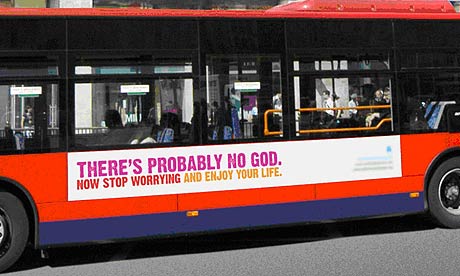
In the UK, there is a new advertising campaign for atheists. It is spearheaded by you guessed it... Richard Dawkins. He is matching penny for penny, any donation that is made. The first phase of this campaign is buying add space on buses with the following expression, "There probably is no God, so stop worrying, and enjoy your life." The plan is to get two sets of 30 buses with the slogans in the side, and have them drive around Westminster for four weeks.

As an atheist, I have mixed feelings about this. One part of me thinks its great. Its making atheist culture acceptable. It makes not believing in God seem a little more tangible. It injects atheism into pop culture. It makes atheism a little less "crazy".

On the other hand, I feel like advertising for atheism is pretty weird thing in of itself. It appears as though Dawkins is trying to centralize atheism, which I am not sure if I like. In the short term, that might be beneficial, as people begin to lose faith in God. But I feel like having a centralized atheist movement might just replace religion with another dogmatic institution. I have never had a problem with just religion, my problem has always been with dogmatic views. If you dogmatically don't believe in God, I have just as big of a problem with your beliefs as if you dogmatically do believe in God. I care more about your intentions and the method by which you arrive at your beliefs, than I do the outcome of that process.

If modern religion is to every truly die out, its not going to happen by putting up billboards on buses. Its going to happen through education in the sciences. As people learn more about their natural world, and begin to use evidence to shape their world views, they need less and less dogma to explain their world. This simply means, they simply don't need God anymore. God becomes an obsolete explanation.

I understand religion has many more uses than just to satisfy curiosity. There are thousands of social functions that religions provide in nearly every society. (Whether I want to admit it or not). And if we were to magically whisk away religion, there would be a huge void in our society of these services. And so, we can't just whisk away religion. The only responsible way to get rid of religion is to slowly erode it away through increased education in the sciences. If we slowly erode religion away, the social functions that it provides will be replaced by a different sense of community. Personally, I hope secular humanism will take its place

http://en.wikipedia.org/wiki/Secular_humanism

So what do you guys think?


Sources:

http://www.guardian.co.uk/commentisfree/2008/oct/21/religion-advertising-atheistbus

http://www.guardian.co.uk/commentisfree/2008/oct/21/religion-advertising

http://www.guardian.co.uk/uk/2008/oct/22/religion-atheist-dawkins-god

3/12/08

Unintelligent Design

God is supposed to be an all knowing, and all powerful being. He is supposedly our creator, and the creator of the universe. Furthermore, the universe is supposed to be our playground. According to the bible, the universe exists for us.

If these statements are all true, then God has some explaining to do. The human body is riddled with limitations that any competent engineer would spot. Also, the universe is FAR from a friendly place for the survival of the human race.

First, lets examine how imperfect, and how limited the human body is. Keep in mind, that we are supposed to be the creation of an all knowing and all powerful being.

As humans, most of us face the following problems:

1. The way that our DNA is made, we are susceptible to cancer thats caused by ultra violet rays from the sun. These rays mutate our DNA in our cells, causing them to go haywire, and replicate like crazy until it kills us.

2. For most of us, our wisdom teeth either grow in at an awkward angle, causing the rest of our teeth to become too crowded. For some of us with larger mouths, we have the room for these extra teeth, but flaps of skin grow over them, guaranteeing the onset of cavities.

3. Inheritable diseases. Some people don't have a choice in what diseases they are born with. Some diseased are presumed to be human caused, ie Autism caused by higher levels of Mercury. However, many diseases are inherited through our genes. An example of this is Alzheimer's disease. In Alzheimer's disease, broken proteins aggregate in certain parts in the brain, preventing the synapses in your brain to work properly.

4. Because we breath, talk, and eat through the same passage, a certain percentage of us is GUARANTEED to die of choking every year.

5. People claim that the human eye is a wonderful piece of engineering, and although it is very sophisticated, it is also very limited. We can only see a tiny sliver of the electromagnetic spectrum. The entire electromagnetic spectrum reaches to near infinity in both the longer and shorter wavelengths that are beyond our range of vision. Anyone who has an appreciation of the entire electromagnetic spectrum can see just how limited our vision is.

6. A certain percentage of all new born babies will be born dead. Most of the causes of still-born babies is unknown, and is not man made. This implies that by design, God wanted a certain percentage of all fetuses to be naturally aborted.

7. Our head is proportionally huge for our bodies. As a result we have S-shaped spines so that way have better balance. This leads to lower back pain later in life, because so much strain is put on our lower backs to keep our head up.

In addition to all these problems with our bodies and brains (There are many more), this supposed Garden of Eden that we live in, is far from a favorable place for us to live.

1. If you look at the volume of the universe in which we CANT survive, it becomes obvious that this universe was not designed for our existence. If you don't quite know how small the earth really is, just think that the earth orbits our sun. And in the milky way galaxy, there are hundreds of billions of stars, just like our sun. And in our universe, there are hundreds of billions of galaxies, each one containing hundreds of billions of stars. Thats billions, with a "B".

Even in our own small corner of the universe, the Earth is in a shooting gallery of things trying to kill us. The Earth gets hit by asteroids every 100 million years or so that will terminate all life on it, we have cosmic rays that give us cancer, and eventually the sun will engulf the Earth, guaranteeing that all life on Earth will end.

2. Even our own planet is out to kill us. Between natural disasters like hurricanes, tornadoes, and tsunamis, that kill hundreds of thousands of people every decade (year?), and naturally occurring bacteria and viruses that replicate, feed, and eventually destroy our bodies, we have a lot going against us.

2/3 of the Earth is covered in water, places where we cannot live. Even on land, a sizable percentage of the Earth is uninhabitable desert, tundra, or ice lands.

All these ideas don't even include the amount of death caused by the notion of free-will that God was supposed to have given us.

I think Epicurus was on the right track when he said the following in 33AD:

Is God willing to prevent evil, but not able?
Then he is not omnipotent.
Is he able, but not willing?
Then he is malevolent.
Is he both able, and willing?
Then whence cometh evil?
Is he neither able nor willing?
Then why call him God.


If after reading all this, you can look me in the eye, and say both of the following things to me: #1 That God is loving, and #2 God is competent, than I would love an explanation from you, because to me, thats absolute hogwash.

Sources:


Neil deGrasse Tyson giving a presentation at the 2006 Beyond Belief conference. You should watch this video, hes a funny guy and has far more charisma than I ever will. Oh, and he was the astrophysicist that was on the Colbert Report a couple weeks ago. So kids, hes a cool guy.

3/9/08

The Meaning of Life

What is the meaning of life? If you were to ask me, I would tell you it depends on the context of the question. What is the meaning of life relative to what culture, to who's family, to what universe? There is not an absolute meaning of life, but why should there be? Why do we have this narcissistic need for centrality? The major religions have been telling us for so long that the universe is here for us. Well, I say that we are not divine beings, and are not worthy enough to have absolute knowledge. For when humans claim to have absolute power and knowledge we are capable of atrocious things; absolute knowledge opens the door for for dogma. Take for examples, the Holocaust, the Crusades, or modern Islamic terrorism, these three things have one thing in common: they are founded on dogma.

My point is that we make our own meaning to life. We define what goals we want to achieve, relative to our social and intellectual surroundings. If you just want to be happy, than by all means, find meaning in your life by creating happiness for yourself. We can have more than one meaning of life. From a biological standpoint, the goal of life is to pass on one's genes, but this particular meaning has no relevance to how to treat your family and friends.

There is no absolute meaning to life, only relative meanings. I am sure its possible to define happiness through biological interactions, but it is certainly not useful to define happiness in such a way because it is so far removed from every day practice.

We know a lot about life, and the universe, and at the same time we know so little. We are so limited by our senses and human biases. We are searching for purpose, for something larger than life. Well, I say that there is no absolute purpose to life, the only purpose we can discover is in the purposes of life that we define.

Discover what you enjoy, who you care about, what you like doing, and what you are passionate about, and make those things the meaning of your life. If you feel empty because you feel like there has to be something more, stop looking for things that are out of this world, and take a look around you. The World has a lot to offer, if you only keep your eyes open.

Find meaning in the life around you, we all have a purpose - just not a divine purpose.

11/12/07

Just some random thoughts and questions

What percentage of the bible do you have to believe in to be considered a Christian? By what method are you allowed to cherry pick what beliefs to believe in?

There is no religion in general, there are only specific religious beliefs. Let's assume that the bible has 10,000 specific beliefs. Some are more important than others, but how do we determine what beliefs are more important?

I wish I could make a list of every single belief in the bible, and rank them in order of importance. Obviously the belief in God is #1, maybe followed by belief in the soul, and heaven and hell? I am just guessing.

I think it would be interesting if we could rank all 10,000 or so beliefs in the bible, and ask every US citizen exactly what beliefs they believed. This would give a true percentage of how "Christian" the U.S. is.

Is being a good Christian and a good person the same thing? What does it mean to be a good Christian? does it mean to believe in more Christian beliefs? what about those ones that call for discrimination or harm to others? What about those benign beliefs that end up being bad (the notion of a soul and that life is sacred preventing stem cell research). I think it is clear that being a good Christian and being a good person are not the same thing... they most definately have overlaps, but are not equal.

I know there are more religions than just Christianity, I just think about what I see the most. n Does anyone else have any questions or thoughts? Leave comments.

10/7/07

My response to Pauri's response

I have read Pauri's response several times now, and I actually agree with almost all that he said. But I think we draw different conclusions from it. To clarify, let me try to make clear exactly what I believe.

Before I go on, let me define the words I am using so there is no argument over syntax or meaning. When I talk about God, I am talking about a personal God. If somebody believes God to be the universe in which we exist, or a set of physical constants that allows life to exist, similar to the God Einstein talked about, I am perfectly fine for that. I think this version of god is a form of mysticism, and not needed to explain the universe, but alas, it is not dangerous. So when i talk about God, I am talking about a personal God who dwells in human affairs and feelings, NOT a God of universal constants.

I believe in freedom of religion. As a citizen of any free world, I believe that we should have the right to believe whatever we want about the universe (as ignorant as that belief may be). And if those people kept their religious convictions to themselves, I would be okay with that. But we live in a democracy, and people with dogmatic beliefs have political power, and they have influence over how I live my life. On multiple occasions the President of the United States, the most powerful nation in the world, has said that he has been in dialog with God. Can you imagine how scary that is to hear from an Atheist's point of view. That the president hears voices in my head, and he is convinced that they are the voices of an omnipotent being. It is frightening.

With that said, I want to say that I do not care about what people want to believe, or what they find comforting - I care about the truth. Not somebody's interpretation of the truth, but an unbiased (as close as humans can get) interpretation of the truth. I realize every culture is going to have a bias that we are not even aware of, but science is the best thing we have to form unbiased analysis. Science is not an infallible form of obtaining knowledge, but it is the closest system that we have.

I don't think that I have to argue too far that people's beliefs directly influence their behavior. If somebody believes that they can fly, they will have no problem jumping off of a bridge. If somebody believes that homosexual behavior is a sin, they will most likely vote for a politician who is against gay marriage. If somebody believes that the soul exists, and that embryos have souls, then they will be more likely to vote against federally funding stem cell research and to help stop the suffering of tens of millions of people.

I never said that getting rid of religion would rid the world of evil. This quote perfectly summarizes my feelings about the effects of religion on people in terms of good and evil:

"With or without religion, you would have evil people doing evil things, and good people doing good things. But it takes religion to make good people do evil things" - Steven Weinberg

One does not have to go farther than ponder the motivations of the Islamic terrorists who attacked the United States on 9/11, or the shoebomber, or the attack on the USS Cole. Most of the hijackers were of middle to upper class, and well educated. These men were not impoverished or dumb. They were well educated who were deluded by their religion, as talked about in this NY Times article. Their world view was based on their religion. They truly believed what they were doing was the right thing to do. I doubt these men committed these atrocities out of a desire to inflict pain. These were educated, smart, moral men who committed atrocities because of their beliefs.

Let me ask a question. What does Christianity, Islam, Stalinism, and Nazism all have in common? Their belief structures are founded on ignorance, arrogance, and dogma. There is no general religion, there are only specific religious beliefs. And some of these beliefs are frankly, bad ideas. Ideas that are either flat out wrong or dangerous. It doesn't matter what "-ism" your
beliefs happen to fall under, it doesn't make the idea any less bad.

But now, lets examine how one would get rid of religion. You would do it through education of the sciences. There is a direct correlation between belief in a personal god and level of scientific education, especially education in biology. The least amount of belief in a personal God comes from evolutionary biologists with PhD's. Maybe this is true because these people are the least ignorant. (i apologize for not citing this study, i will eventually... it might take a while to go through everything I've watched/read and find this again.)

We live in a society where faith is a virtue. Somebody is seen as a good, moral person if they have strong faith. This sickens me. Faith is NOT a virtue. Faith should be a joke. It should be laughed at. This seems like it contradicts my previous statement about freedom of religion. I do not think that it does. From a legal standpoint I think that we should be able to believe in whatever we want. But as a society, we need to criticize ideas that are dangerous and wrong.

The alternative to religion that I am a proponent of, is secular humanism. I believe that secular humanism is a method by which we can maintain our humanism, refine our morals, and give up our dogmatic beliefs. We can leave behind the mostly obsolete books about morality and creationism, and have a modern conversation about ethics. No longer will we be handcuffed towards social progress by the old ways of religion.

So, I hope this clears up where I stand on some issues. My real "beef" is with dogma and bad ideas, religion just happens to be very dogmatic and filled with bad ideas. It is hard to argue on some issues, such as if the net amount of evil will decrease without religion, because there is no supporting evidence either way. With no statistical evidence to support either idea, it seems almost useless to argue. Giving specific anecdotal stories only goes so far.

Thanks to anyone who read this long post.

10/2/07

my response

I will freely admit that arguing with someone when you know there is a 0% chance that that person will even consider changing his or stance, or his or her perspective is a little like banging your head against a brick wall. It is infuriating to listen to someone extol the virtues of (in this case) his view without realizing that a knowledge and understanding of the other perspectives is requisite for a true understanding of the subject at hand.
Now, this does not mean that a proponent of empiricism and/or rationalism (those whose infatuation of science emanates from them) must attempt to become a religious person, a person of faith, a spiritual person, or a person who believes in that which would not be considered secular (and yes, I realize that a definition by negation is a cop-out, but it'll have to do). This requires a leap that the person who discredits religion cannot and should not have to make.
What that person must do, however, is understand the role that religion plays in the lives of people - and importantly, recognize all the socio-political forces that have combined to establish the perspective of both the religious person and the secular person.
In that regard, I implore the person discrediting religion to read Marshall Hodgson's "The Great Western Transmutation," for example, to see how his or her perspective came to be.

Furthermore, it is necessary for this same person to not put blame on "religion," when blame is to be put on people. "Religion" does not do anything. People do things. This is not to say that religion is inherently good and that anything "bad" done in the name of a religion is a perversion of that religion. Some people do "bad" things under true religious conviction. But it would be naive to argue that there aren't economical, for example, causes that the secularist chooses to ignore in assigning blame. Religion is an easy scapegoat, and for now, it is imperative that it not go anywhere. If it goes, people will have to blame themselves, their governments, their economies, and other components of social life for the same amount of "bad/evil" in the world. Getting rid of religion will not get rid of evil, it will not decrease it, it will only change the vocabulary around assigning blame by the secularist.
So let us pray that religion stays, the world isn't ready for reality.

"The most barbarous and the most fantastic rites and the strangest myths translate some human need, some aspect of life, either individual or social. The reasons with which the faithful justify them may be, and generally are, erroneous; but the true reasons do not cease to exist."
- Emile Durkheim